
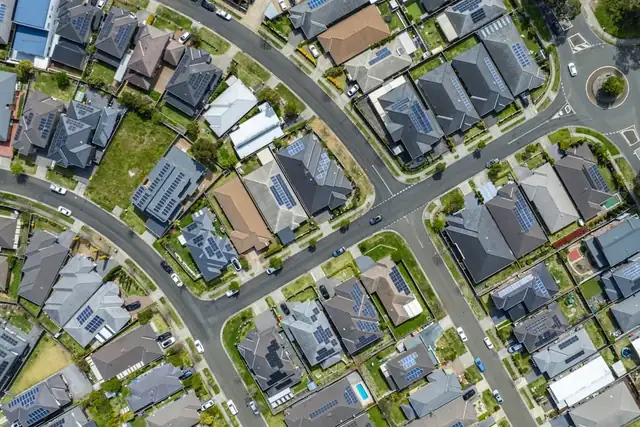
Under the NSW low and mid-rise housing policy, since 1 July 2024 dual occupancies and semi-detached homes are permitted, with council consent, in R2 low-density zones across NSW. Since 28 February 2025, within 800 metres of 171 nominated stations and town centres, a dual occupancy cannot be refused on lot size if the block is at least 450 square metres and 12 metres wide.
| Housing type | Minimum lot | Minimum width | Floor space ratio | Height |
|---|---|---|---|---|
| Dual occupancy | 450 m2 | 12 m | 0.65:1 | 9.5 m |
| Terraces | 500 m2 | 18 m | 0.7:1 | 9.5 m |
| Multi-dwelling housing | 600 m2 | 12 m | 0.7:1 | 9.5 m |
What did the policy change?
The policy is part of the State Environmental Planning Policy (Housing) 2021 and came in two stages. Stage 1 permitted dual occupancies and semi-detached homes in R2 zones statewide. Stage 2 added non-refusal standards, sometimes called non-discretionary standards, for low and mid-rise housing in areas within 800 metres walk of nominated town centres and train or light rail stations in Greater Sydney, the Central Coast, the Hunter and Illawarra-Shoalhaven. The Government expects up to 112,000 homes over five years.
Does it apply to your block?
Check three things: the zone, whether the block is inside a mapped low and mid-rise housing area, and whether an exclusion applies. Exclusions include heritage items, land with high aircraft noise, Transport Oriented Development areas, and the Hawkesbury, Blue Mountains and Wollondilly local government areas. Flooding or bushfire constraints can also exclude a property. Outside the mapped areas, a dual occupancy in R2 is permitted with consent, but council’s own lot size and other controls apply.
Can you subdivide afterwards?
In R1, R2 and R3 zones within the mapped areas, the standards allow subdivision of a dual occupancy into lots of at least 225 square metres and 6 metres wide each. That is what turns a dual occupancy into two separately titled semi-detached homes, which matters for selling one side and for lending.
How is building a dual occupancy financed?
Most owners use a construction loan, drawn in progress payments as the build reaches each stage. What lenders look at:
- Your plan for the finished homes: keep both, live in one and rent the other, or sell one.
- The valuation as if complete, for each dwelling, which sets how much can be lent.
- A fixed-price contract with a licensed builder and home building insurance.
- Whether it is residential lending or development: a single dual occupancy is usually residential; larger projects move to development finance.
The duplex and dual occupancy finance page explains the lending in detail, and development finance covers bigger projects.
A worked example
A family in Sydney’s south-west owns a 600 square metre R2 block, 15 metres wide, within 800 metres of a nominated station. Under the standards a dual occupancy of up to 390 square metres of floor area (0.65 times 600) and 9.5 metres high cannot be refused on those grounds. They knock down the old house, build two homes, subdivide into two 300 square metre lots, keep one and sell the other. The sale repays most of the construction loan, leaving a much smaller loan on the home they keep. Council consent is still needed and every other control must be met.
What costs should you plan for beyond the build?
- Design, approvals and consultants, such as surveys, engineering and a planner.
- Demolition and site works, including connections for a second dwelling.
- Subdivision costs, including surveying, council certificates and new titles.
- Holding costs: interest on the land and the drawn loan, and somewhere to live during the build.
- Selling costs if you sell one dwelling, and transfer duty for the buyer to consider.
Lenders want to see that your budget covers all of these, not just the builder’s contract price, plus a buffer for overruns.
What about negative gearing on the new homes?
Replacing one home with more dwellings counts as adding supply, which is how the 2026 tax changes define a new build. A dwelling built this way that you rent out can still be negatively geared after 1 July 2027. The article on negative gearing changes explains the rules, which are being finalised by a legislative instrument.
Questions people ask
Can I build a duplex in an R2 zone in NSW?
Yes, with council consent, since 1 July 2024. In mapped low and mid-rise areas, non-refusal standards apply to lot size, width, floor space and height.
What is the minimum lot size for a dual occupancy?
In mapped low and mid-rise areas, a dual occupancy cannot be refused on lot size if the block is at least 450 square metres and 12 metres wide. Elsewhere, council controls apply.
Does the policy apply in the Blue Mountains or Hawkesbury?
No. Those local government areas, and Wollondilly, are excluded because of bushfire, flooding and evacuation risks.
Where can I see which areas the policy covers?
NSW Planning lists the 171 nominated stations and town centres on its low and mid-rise housing policy page. The planning certificate for a block shows its zoning, and the council or a town planner can confirm whether it sits within a low and mid-rise housing area.
Charles Touma works out how a dual occupancy can be funded before you commit to plans, including whether it fits a residential construction loan. A free 30-minute call covers the numbers. General information only, not planning, legal or credit advice; confirm what applies to your block with council or a town planner.
Sources: NSW Planning, Low and Mid-Rise Housing Policy; summary of key provisions; policy questions and exclusions, checked 18 October 2026.
General information only, not credit, legal or tax advice. Your situation is assessed properly before any recommendation. Government scheme details change; figures are current at the time of writing.

Talk it through with Charles
A free 30-minute call: your borrowing power, deposit options and the next step.