
Links Property Finance · Home loans for first home buyers: First Home Buyer FAQ
Deposits, schemes, stamp duty, borrowing power and family help, without the jargon.


What do first home buyers ask most?
How much deposit they need, whether the 5% Deposit Scheme fits, how much stamp duty they will pay, how much they can borrow, how family can help, and how long approval takes.
Read more
The answers below are grouped in the order those questions usually come up, each linking to the page that covers it in depth.
Part of the first home buyer loans guide.

From first deposit to the keys
Charles Touma answers these on the call too.
Recent Links clients, including first home buyers
-

Sold. Her first home. Deposit, scheme and lender, sorted. -
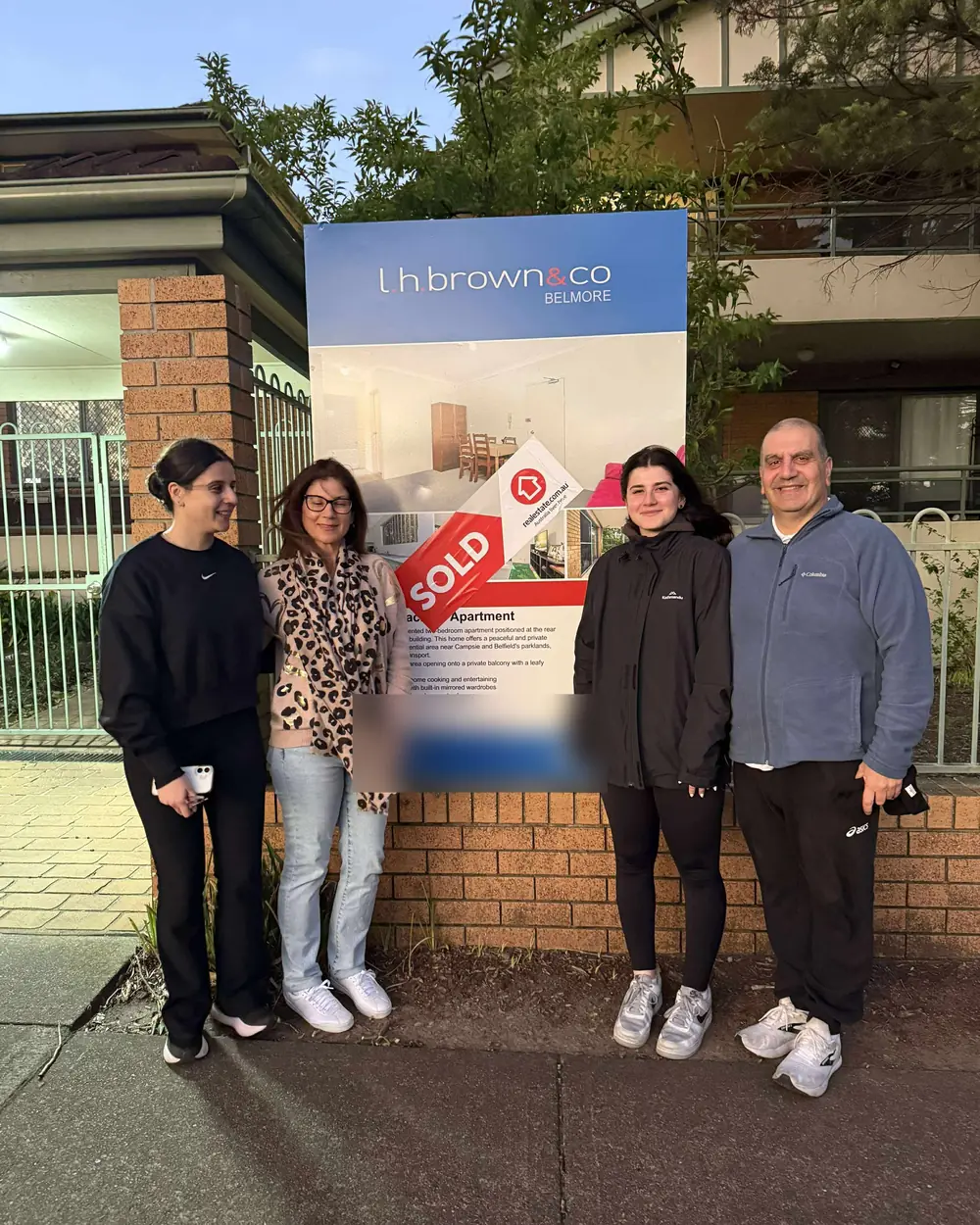
The whole family turned up. A parents’ guarantee, done properly. -
Next one
Your sold sign could be next.
A free 30-minute call shows where you stand.
Book my free call


From first deposit to the keys
How much deposit do I need for a first home in Sydney?
Often 5 per cent, through the 5% Deposit Scheme if you are eligible. Lenders prefer 20 per cent because it avoids lenders mortgage insurance, but that is not the minimum.
Eligible buyers can purchase with a 5% deposit under the Australian Government 5% Deposit Scheme and pay no mortgage insurance, and buyers outside the scheme can often borrow with 5 to 10% if the insurance is added to the loan.
A family guarantee can stand in for the deposit altogether. Whichever route fits, you also need cash for conveyancing, inspections and government fees, plus transfer duty if you are not fully exempt. The first home buyers guide compares each route.
How does the Australian government 5% Deposit Scheme work?
The government guarantees the part of your loan between your 5% deposit and the 20% a lender would normally want, so the lender treats the loan as fully secured and no lenders mortgage insurance is charged.
You still borrow the full amount and make every repayment yourself, because the guarantee protects the lender rather than you.
The scheme is administered by Housing Australia, but you do not apply to Housing Australia yourself: a participating lender arranges the guarantee while it assesses your home loan. There are no income caps and no limit on places. The NSW schemes guide shows where it sits alongside the state concessions.
Who can use the 5% Deposit Scheme?
Each applicant is assessed on citizenship or residency, their intention to live in the home and their ownership history.
The scheme is built for first home buyers, though in some circumstances people who have not owned property in the last ten years can qualify too, while the NSW stamp duty concession still looks at whether you have ever owned.
You can apply alone or with one other person, such as a partner, a friend or a sibling, but not as a group of three or more. The price must also sit within the cap for the area.
There is no income test, and a HECS debt does not affect eligibility. The 5% Deposit Scheme checker gives a quick first read, and Housing Australia and your lender confirm where you stand.
What are the 5% Deposit Scheme price caps in NSW?
In Sydney the cap is $1.5 million, and the same figure applies in the NSW regional centres: Newcastle, Lake Macquarie, the Illawarra, the Central Coast, Coffs Harbour–Grafton, the Mid North Coast and Richmond–Tweed.
Across the rest of the state the cap is $800,000. The cap applies to the purchase price, so a home above it falls outside the scheme whatever your deposit.
These caps are separate from the NSW stamp duty thresholds of $800,000 for the full exemption and $1 million for the end of the concession, so a purchase can qualify for one and not the other.
Caps are set by government and reviewed, so the current figure is checked when your application is prepared. Our guide to NSW first home buyer schemes covers the rest of the scheme’s rules.
Can I use more than one first home buyer scheme?
Often, yes. For eligible NSW buyers the usual pairing is the 5% Deposit Scheme with the stamp duty exemption or concession: one deals with the deposit and mortgage insurance, the other cuts the upfront cost.
The $10,000 First Home Owner Grant can be added only on an eligible new home, never an established one.
Help to Buy, where the government takes an equity share, is generally an alternative to the 5% scheme rather than an extra layer.
The First Home Super Saver Scheme is a way of saving the deposit, so it can sit alongside the purchase schemes. The NSW schemes guide sets out each one.
Can I save my deposit through my super?
Yes, through the First Home Super Saver Scheme. You make voluntary contributions to your super fund on top of what your employer pays, then apply to the Australian Taxation Office to have those contributions, plus associated earnings, released towards your first home. Only voluntary contributions can be released, never your employer’s compulsory ones.
Lenders generally treat the released money as genuine savings. The trade-off is access: the money is harder to reach if your plans change, and the release runs on the ATO’s process and timing, so build it into your plan early.
Contribution and release limits are set by the ATO and change, so check its current figures or speak to a tax adviser before contributing.
Is it worth paying lenders mortgage insurance to buy sooner?
Sometimes. The insurance protects the lender rather than you, the premium rises steeply as your deposit shrinks, and because it is usually added to the loan you pay interest on it over the life of the loan. Against that, saving to 20% can take a long time while prices move.
If you are close to 20% already, waiting usually wins; if you are several years away, the premium can be the cheaper outcome.
Before paying it, check whether the 5% Deposit Scheme or a family guarantee would remove it altogether. It is an arithmetic question, best answered with your real numbers rather than a rule of thumb.
How do lenders work out how much I can borrow?
They start with your income, subtract your living expenses and existing commitments, such as car loans, credit cards and any HECS repayment, and test whether what is left could meet the repayments at an assessment rate set above the rate you would pay.
Credit cards are assessed on the limit rather than the balance, so an unused card still counts.
Your deposit does not lift this ceiling; it only changes how much you need in the bank. Lenders also read casual and self-employed income differently, which is why the same person can get different answers from different lenders. The borrowing power calculator gives a starting range.
Does a HECS or HELP debt reduce my borrowing power?
Yes, but the balance is not what matters. Lenders look at the compulsory repayment taken from your pay, which is set by your income, and treat it as money that cannot go towards a mortgage.
Because they assess at a rate above the one you would pay, a modest yearly repayment can reduce your borrowing capacity by a noticeably larger amount.
Paying down part of the balance rarely helps, since the repayment stays the same unless the debt is cleared. A HELP debt does not appear on your credit file and does not affect scheme eligibility. The HECS and home loans guide explains how treatment varies.
What do lenders look for when my income is casual, on probation or self-employed?
Evidence that the income is likely to continue. For casual work, that usually means how long you have been in the role or the industry and how steady your hours have been, shown through payslips and a year-to-date figure.
On probation, lenders look at your experience in the same line of work, and a letter from your employer can help.
Self-employed income is generally read from tax returns and notices of assessment, sometimes alongside business activity statements. Each lender weighs this evidence differently, so matching the application to the right lender before it is lodged matters. The employment and income guide covers each type of income.
How does buying with a partner change the numbers?
A joint application combines both incomes and both sets of commitments, so a car loan or HECS repayment in one name reduces the household figure as if it were shared.
For most couples the combined result is still stronger than either person alone. You each become liable for the whole loan, not half of it.
Eligibility needs checking early too: the NSW stamp duty concession generally requires every purchaser to qualify, so one partner’s past ownership can affect you both. Lenders assess de facto couples the same way as married ones. The buying with a partner guide covers how to hold the title.
Do first home buyers pay stamp duty in NSW?
Not up to $800,000, if you are eligible. Under the First Home Buyers Assistance Scheme there is no transfer duty on a home up to and including that price, a reduced concessional amount between $800,000 and $1 million, and full duty above $1 million. Unlike the First Home Owner Grant, it is not limited to new homes.
Eligibility depends on the buyers and the property, including never having owned residential property and moving in within a set period, and all purchasers generally need to qualify.
Revenue NSW sets the rules and confirms eligibility, and your conveyancer pays the duty around settlement. Use the stamp duty calculator for your price.
What happens to stamp duty between $800,000 and $1 million?
The exemption tapers rather than stopping. Just above $800,000 the duty is small, and it climbs steadily with the price until it reaches full duty at $1 million.
There is no sudden jump at either end, but the climb through this band is steep, so each step up in price adds to your duty as well as to your deposit and loan.
If you are weighing up two homes either side of $800,000, compare the total cash each one needs rather than the price alone. Running both prices through the stamp duty calculator before you bid shows the real gap.
What costs should I budget for on top of the deposit?
Conveyancing and searches, a building and pest inspection or a strata report, government transfer and mortgage registration fees, any lender application or valuation fees, and the council and water rates adjustment paid to the seller at settlement. Add transfer duty if you are not fully exempt, plus removalists and connections.
Most are modest on their own, but together they add up, and they generally come from your own cash rather than the loan.
It is also sensible to keep a buffer after settlement, and around three months of repayments is a reasonable target. The stamp duty calculator covers the largest of these where it applies.
How does a family guarantee work?
A parent, or at some lenders another close family member, offers a limited, written amount of equity in their own home as extra security for your loan.
No money changes hands and they make no repayments. Because the lender holds more security, mortgage insurance usually falls away, even with little or no deposit of your own.
The guarantee typically covers the gap to 20% plus buying costs, and it can usually be released once your loan falls to around 80% of your home’s value, subject to the lender and a fresh valuation.
Guarantors commonly need independent legal advice before signing. The guarantor home loans guide explains the risks.
What do lenders need to see if family gifts part of my deposit?
Usually a signed letter from each giver confirming the money is a gift, unconditional and not repayable, and that they keep no interest in the property, plus bank statements showing the funds leaving their account and arriving in yours. Immediate family, most often parents, is the standard giver.
Some lenders still want part of the deposit saved by you over time, while others relax that at lower loan-to-value ratios.
Moving the money early helps, because funds that have sat in your account for months draw fewer questions. A gift fixes a deposit gap but does not lift your borrowing power. The gifted deposit guide covers overseas gifts too.
Is a gift or a guarantee the better way for family to help?
It depends on what your family has. A gift suits a family with spare cash: the money moves once, they carry no ongoing liability, and a gift that takes you to 20% removes mortgage insurance, while a smaller one reduces it.
A guarantee suits a family with equity in their home but not cash: nothing leaves their account, but they take on a real obligation against their property that can affect their own borrowing until it is released.
Neither one increases what you can borrow, which still rests on your own income. The guarantor calculator shows how much of a parent’s equity a guarantee would use, and talking it through together before any money moves or anything is signed avoids crossed wires later.
How is a mortgage broker paid, and whose interests come first?
On most home loans the lender pays the broker, not you. A commission is paid when your loan settles, usually with a smaller ongoing amount while the loan runs, and both are set out in writing before anything is submitted.
If a fee were ever to apply in your situation, you would be told before any work began.
Brokers also have a legal duty to act in your best interests, so the recommendation has to suit you rather than pay the most.
You deal with Charles directly from the first call through to settlement, and the first conversation needs no documents and no credit check. If you would rather start by building your own picture, the free First Home Buyer Report takes about two minutes.
When is the right time to apply for pre-approval?
Once you are close to making offers or bidding at auction, and not long before. You can browse without it, but pre-approval gives you a realistic price ceiling and makes your offer credible to agents.
Because it commonly runs for around 90 days, applying months before you start looking can mean renewing it, often with updated payslips and statements.
A fully assessed pre-approval generally involves a credit enquiry, so one well-timed, well-chosen application is better than several. It is conditional rather than a guarantee: final approval still depends on the property, its valuation and the lender’s final checks. The home loan pre-approval guide explains the timing.
What documents will I need to apply?
Identification, recent payslips and usually a year-to-date figure, and three to six months of bank statements covering your savings and everyday spending.
Add statements for any existing debts, and details of credit card limits, personal and car loans, buy now pay later accounts and any HECS debt. Some lenders also ask for tax assessments.
If family is gifting money, you will need their signed gift letter; if a parent is acting as guarantor, they supply their own identification, property details and a certificate of independent legal advice.
The home loan documents checklist sets these out by situation, and having everything ready before you apply is the part of the timeline you control.
Can I bid at auction as a first home buyer?
Yes, but the rules are stricter. An auction purchase is unconditional, with no cooling-off period and no finance clause, so your finance needs to be organised before you bid.
That means pre-approval, a ceiling that already allows for duty and costs, and the deposit available on the day, commonly 10% unless a lower amount is agreed beforehand, because at auction it is paid when contracts are signed rather than at settlement.
Pre-approval is still conditional on the lender’s valuation, so if the property values below your winning bid, the gap is yours to fund. Having the specific property checked before auction day reduces that risk.
Set your limit before bidding starts, and hold to it. Our guide to the questions to ask before you offer or bid covers what to check first.
What happens between an accepted offer and getting the keys?
A run of steps, most of them handled by other people. Contracts are exchanged and the deposit is paid, and on most private sales in NSW a cooling-off period follows unless it has been waived.
The lender values the property and issues formal approval, your conveyancer completes the searches and prepares for settlement, and you sign the loan documents and arrange building insurance where the lender requires it.
A final inspection comes shortly before settlement. With finance prepared, an established home commonly takes five to eight weeks, so check the dates against your lease before you sign. The first home buyer checklist lists each step in order.
Official sources for the figures on this page: Housing Australia, Australian Government 5% Deposit Scheme · Revenue NSW, First Home Buyers Assistance Scheme · Revenue NSW, First Home Owner (New Homes) Grant. Rules change; the official pages are the final word. Checked against these sources on 12 October 2026.
What could a 5% deposit get you?
What could a 5% deposit get you?
No LMI: an estimated $22,800 premium avoided (a broad guide; real premiums vary by lender and loan).
Stamp duty: $0 for eligible NSW first home buyers on purchases up to $800,000, with concessional rates to $1,000,000. Saving shown is indicative and depends on purchase price. Eligibility criteria apply and are assessed by Revenue NSW.
Indicative only. The deposit excludes stamp duty, legal and inspection costs, and a participating lender, not this calculator, confirms 5% Deposit Scheme eligibility.
Confirm your numbers.
As a first home buyer, I was pretty overwhelmed at the start, but Charles made everything much easier. He explained the process step by step and helped me understand my borrowing options. His professionalism and responsiveness were excellent.
Had a really good experience with Charles at Links Property Finance. He was easy to deal with, always quick to respond and kept everything simple and clear throughout the whole process. You can tell he genuinely cares about getting the best outcome for his clients rather than just getting things done quickly. Really happy with the experience and would happily recommend Charles and Links Property Finance to anyone.
Charles looked after us really well and his knowledge gave us the confidence to purchase our property. He wasn’t pushy and always ensured we felt comfortable with the repayments.



Ask the question this page does not answer
Thirty minutes with Charles usually settles it, for your situation rather than in general. Free, no credit check, no obligation.
Prefer a callback? Charles calls back within one business day. No documents needed yet.


General information only, not credit or financial advice. Lender policies and government scheme criteria differ and change over time. All lending is subject to individual assessment and approval.